I am a master’s student in Electronic and Information Engineering at the University of Science and Technology of China (USTC). I work on robot learning and embodied intelligence, with an emphasis on making manipulation policies adapt to physical interaction and work reliably on real robots.
My work covers the full experimental pipeline: robot and camera calibration, data collection, simulation, model training, inference, control interfaces, and real-robot evaluation. At the Institute for AI Industry Research (AIR), Tsinghua University, I worked with robot arms and a dexterous hand on the Zeva, Zeva-Ego, and Zetta projects.
Fu Chen*, Xin Ding*, Bingjia Huang, Xiangyu Li, Mingju Wang, Jiawei He, Kun Li, Wei Sun, Yunxin Liu, Hao Wu, Ting Cao · Co-first author, listed first
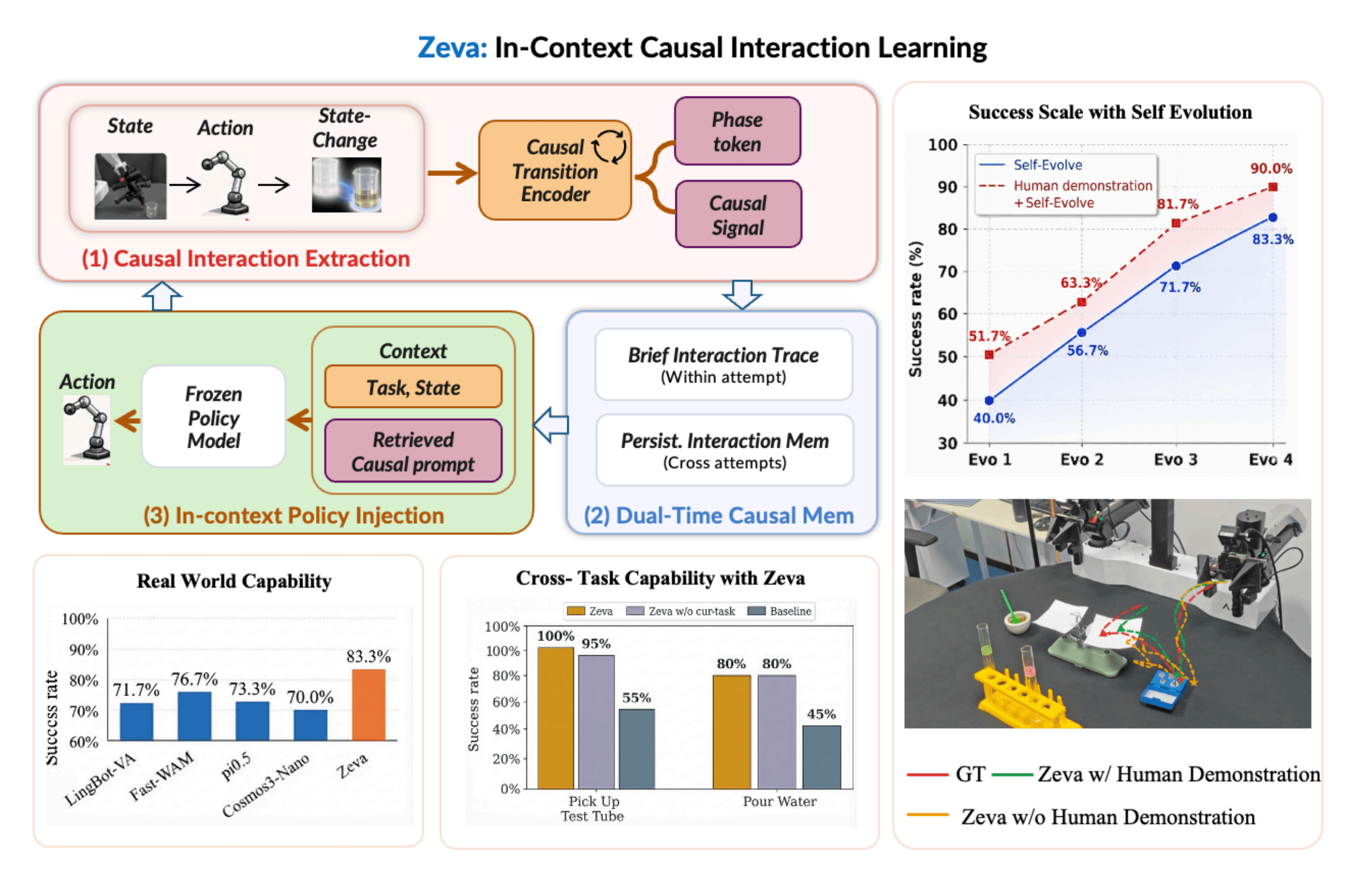
Zeva encodes executed actions and observed state changes as causal interaction signals. A dual-timescale memory retrieves useful experience to adapt a frozen policy without gradient updates. It reached 76.8% average success on RoboCasa365-Atomic5; in a separate repeated-attempt evaluation, cumulative success rose from 26% on the first attempt to 73% within four attempts.
Bingjia Huang*, Xin Ding, Fu Chen*, Kun Li, Wei Sun, Hao Wu, Yunxin Liu, Ting Cao · Co-first author
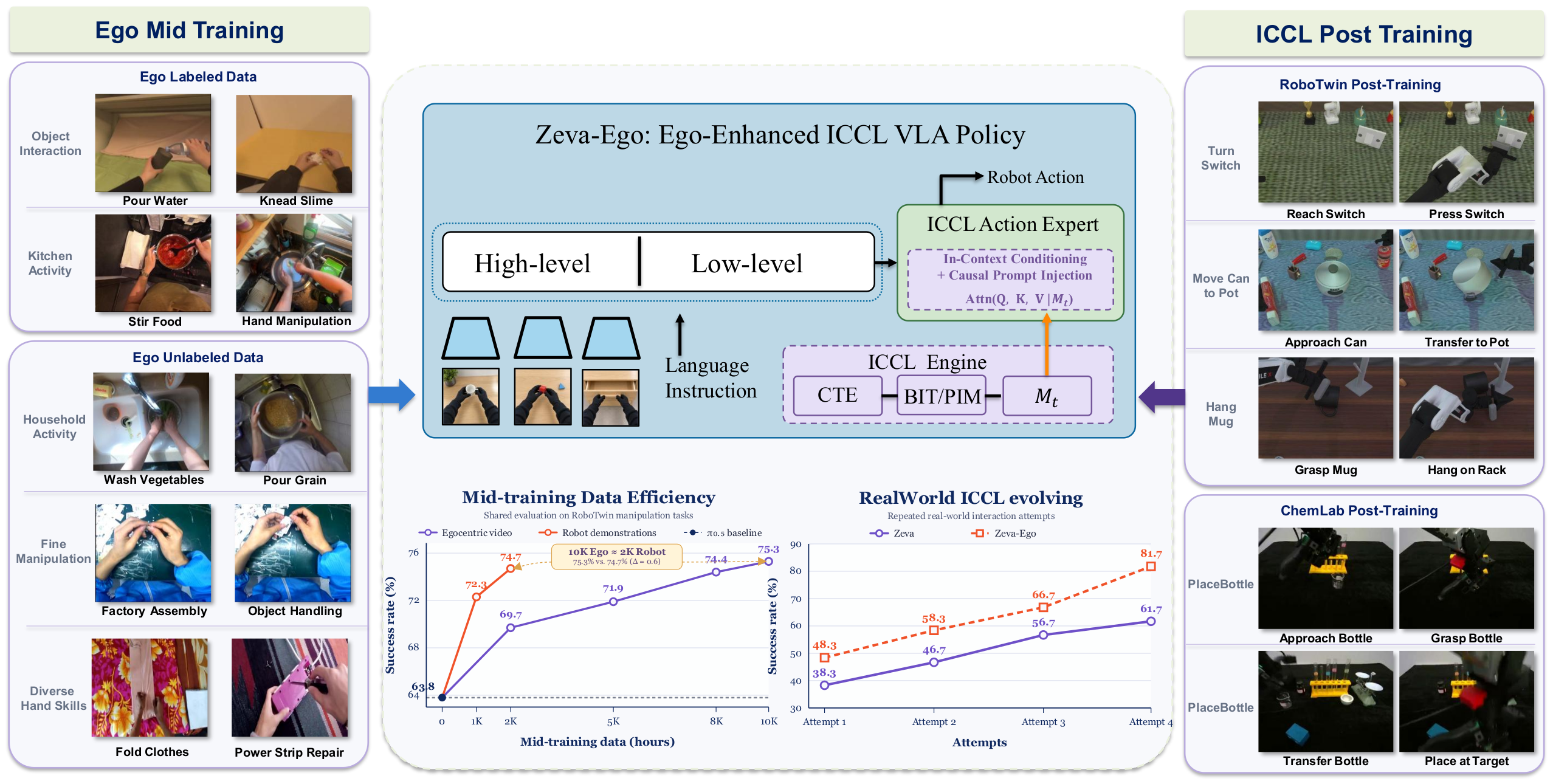
Zeva-Ego turns egocentric video into action-centered supervision for VLA mid-training, then uses interaction feedback for parameter-free adaptation at deployment. Scaling to 10,000 hours of video improved RoboTwin success from 63.8% to 75.3%; repeated-attempt success rose from 58% to 89%.
Xin Ding, Liang Mi, Mingzhe Huang, Zixuan Wang, Chao Zhang, Zixu Hao, Fu Chen, Xiangyu Li, Yikai Zheng, Yaoyu Guo, Weijun Wang, Kun Li, Hao Wu, Yunxin Liu, Ting Cao
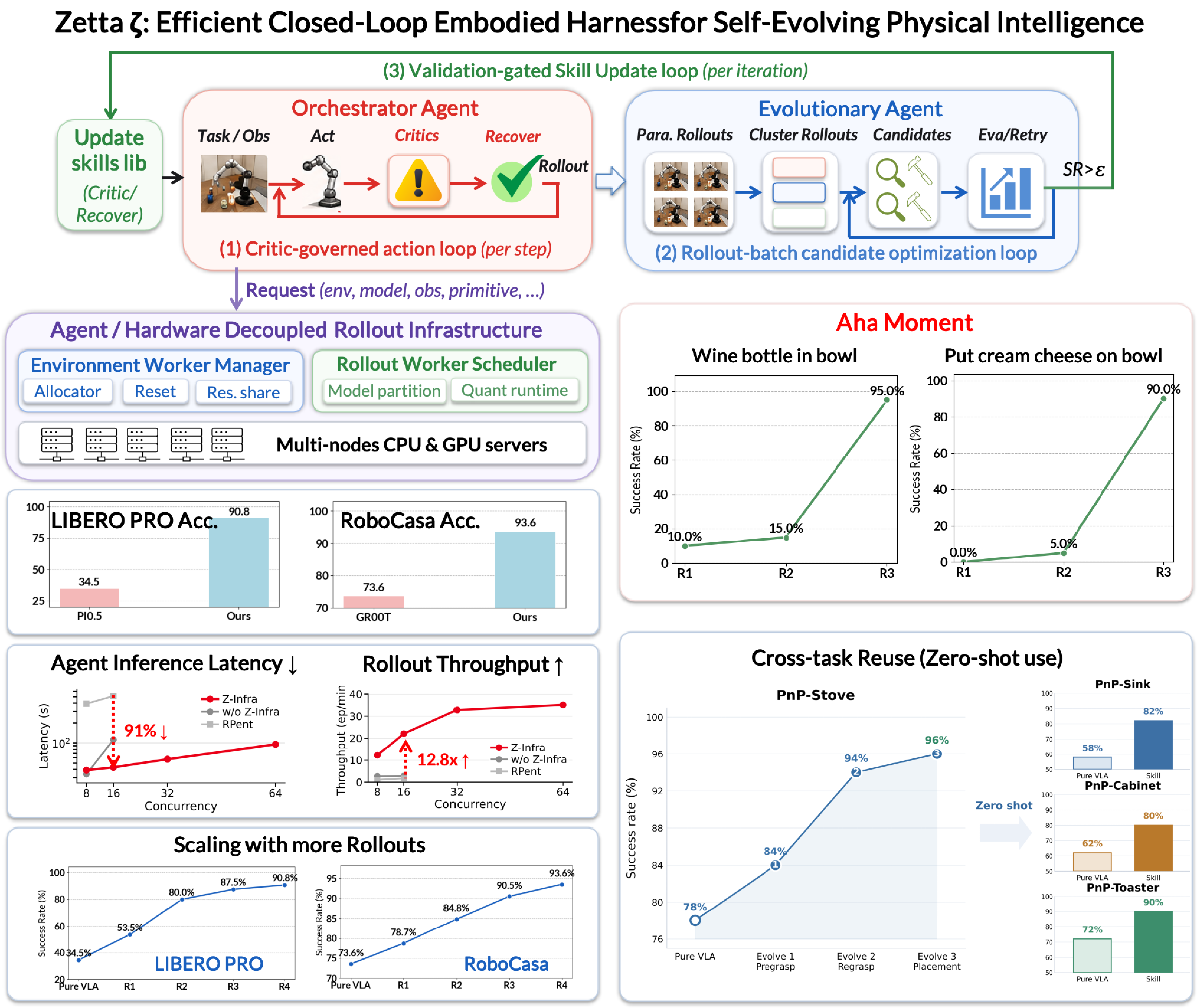
Zetta keeps a base policy frozen while runtime critics detect failures and recovery skills support continued execution. Rollout analysis and validation update those skills over time. The paper reports 90.8% success on LIBERO-Pro, 93.6% on RoboCasa, and an 11.1× inference speedup. I worked on the base policy and implemented real-robot deployment.
Worked on VLA and world-action models for robot manipulation across data collection, training, inference, and real-robot evaluation. Integrated robot arms and a dexterous hand, including calibration and control interfaces. Built a Real2Sim2Real workflow for simulation rollouts, policy training, and transfer back to physical robots.
Research Intern · Eastern Institute of Technology, Ningbo
Jun–Sep 2025
Ran Franka manipulation experiments and reproduced Seer, a predictive inverse-dynamics model, including its training and inference pipeline.
Motion Control Engineer · Gaoqing Electromechanical
Jan–Apr 2025
Developed a C++ SDK for robot walking speed and mode switching. Adapted ModelBasedFootstepPlanning to a 12-DoF biped, trained in simulation, and validated sim-to-sim and sim-to-real deployment with MuJoCo and RKNN.
Education
University of Science and Technology of China
2025–2028 (expected)
M.Eng., Electronic and Information Engineering
Hunan University
2021–2025
B.Eng., Electronic and Information Engineering
Selected engineering work
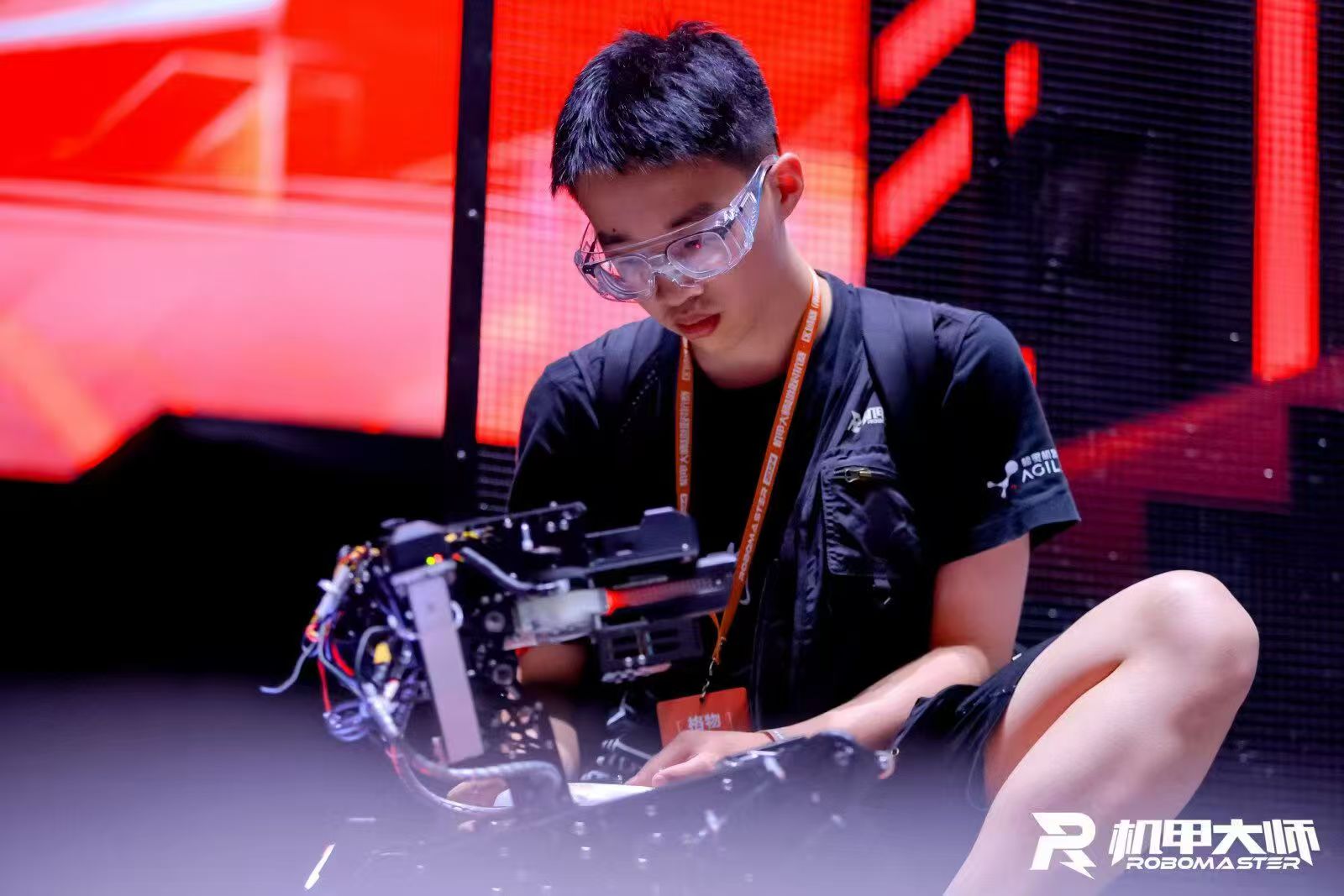
RoboMaster Yuelu Team · Control group leader and team captain
2023
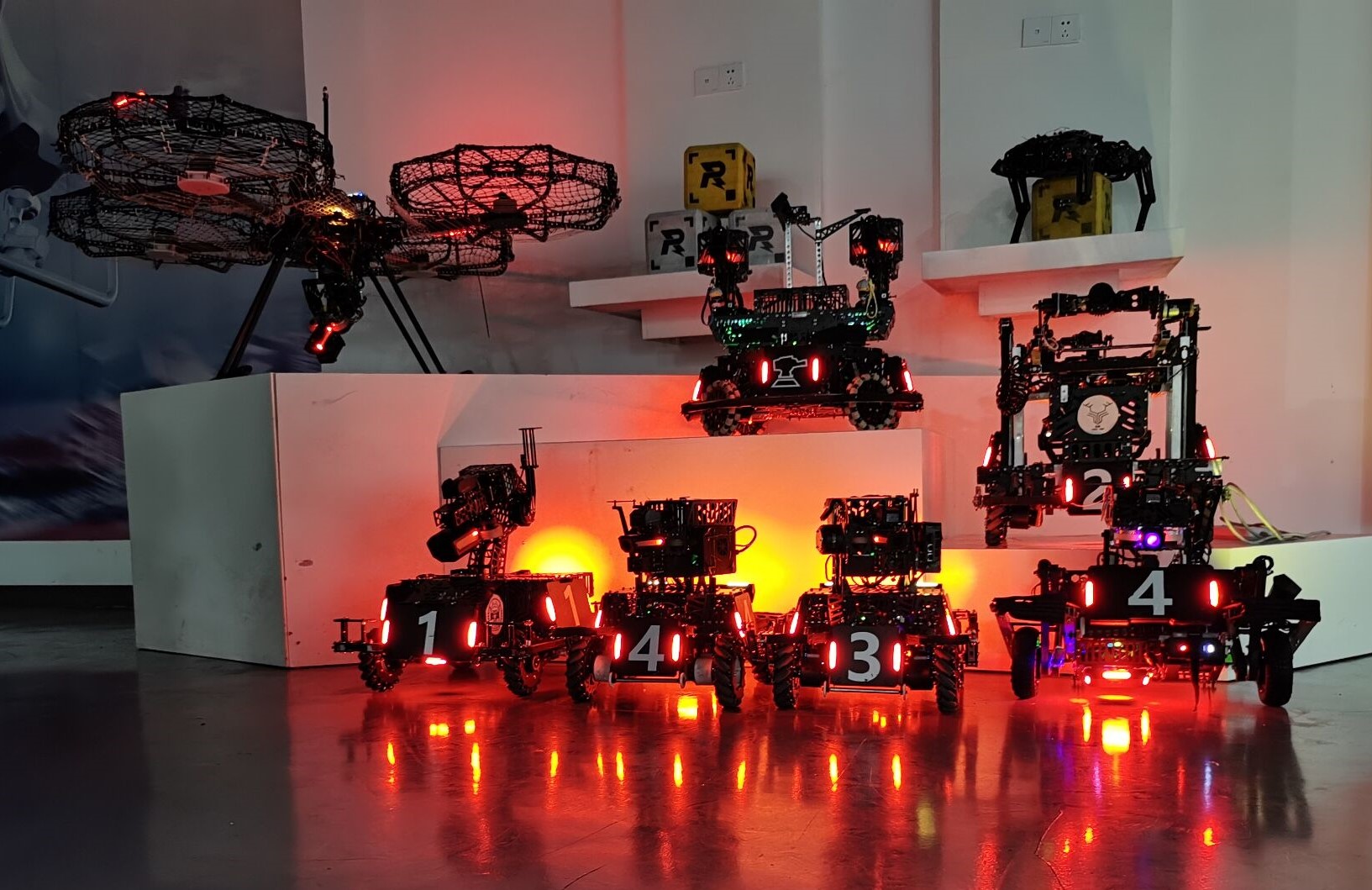
Led a modular embedded control framework with 400+ stars, recognized with the RoboMaster 2023 Open Source Award (third prize). Developed a wheel-legged balancing infantry control system using Kalman filtering and LQR; the team won first prize in the 2023 RoboMaster University League infantry robot competition.
Yuelu Team robots built with basic_framework.
Skills
Programming: Python, C++ · Robot systems: ROS/ROS 2, MuJoCo, Isaac Sim, RKNN · Machine learning: PyTorch, Transformers, distributed training, VLA and world-action models